



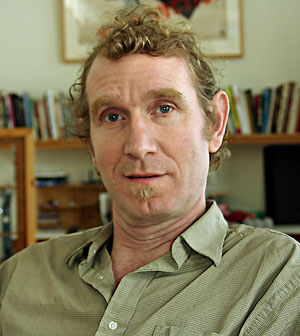
 Born in 1954, Doniphan was painting and making films by the time he got to high school. He spent much of his twenties traveling around the United States, Asia and South America, often hitchhiking and backpacking but also stopping to live with locals or work on projects. Notable among the latter was founding an artist's commune in San Francisco (1975), joining a theatre collective in Peru (1980), studying film (graduated the San Francisco Art Institute in 1990) and in 1980 making a short feature film in Brazil with renown Brazilian photographer Mario Cravo Neto.
In the course of his adventures, Doniphan developed an interest in the “difficult idea,” starting with mysticism and tribal life but soon graduating to the Holocaust after realizing that, despite his mother's quiescence, her suffering triggered in him intense feelings and anger. He devoted a decade to researching its roots and complexities, reading extensively, studying at the Holocaust Center of N. California and New York's YIVO Institute, attending conferences and classes and interviewing his mother and other survivors and writing an article, Bruno Lowenberg: A Holocaust Survivor, which won a North-West Journalism Association Award (1984). He also continued publishing on other subjects like Tobias Schneebaum: Becoming the Wild Man (1985), Drug War Delusions (1991), The Evolution of Capitalism and Advertising (1994) and various articles on film/video (2006-7).
One revelation of his Holocaust research was that the camps were not ruled solely by natural selection, or “survival of the fittest,” as the Nazis intended and most observers concurr. After examining his mother's story — an innocent young woman working as a nurse and not fighting for every scrap of bread — he concluded that “sexual selection,” Darwin's second theory governing reproduction and relationships, played a critical role, an insight he has applied to research on prehistorical matriarchies, male-female dynamics and Islamic history.
Doniphan's focus remained on film and video: studying for his degree, working on commercial productions (sometimes with his father, a lighting cinematographer) and producing his own pieces. He completed various dramatic, documentary and non-narrative shorts: Cancer in the Tropics, 1986 (32 min, 16mm, shot in Brazil and shown at various Latin American festivals), Job, 1988 (20 min video, winner of an award from the 1989 SF International Film Festival), Home Movie, 1990 (20 min, 16 mm, drama) and Talk No Show, 1991 (24 min doc on phone sex workers bought by the San Francisco Human Sexuality Institute). He also collaborated his brother, Nicholas, on America's Culture of Crash, 1996, a documentary about demolition derby.
With the birth of his daughter, Doniphan embarked on a graphic design career while continuing film, video and writing part time. After working for various publishing houses in the 1980's, he started A Media, his own studio, in tandem with his brother's video production, a sister studio in New York. Over the years, he has created a wide variety of graphics, branding, cartoons, photography and copy for nonprofits and entrepreneurs alike: from city-wide AIDS prevention and recycling campaigns to various brochures, books and posters as well as architectural banners for Oakland's African American Museum or T-Shirts for the Dellums' Oakland mayoral campaign, and many web sites.
But he still keeps his big ideas folder full: a Multicultural Institute for Oakland, essays on Darwinism and Religion or The History of Sufism and various film projects. He and his brother are currently working on their next documentary, Heaven and Hell, about the commune they started and he has proposals for other documentaries, like Women's War, about the female side of conflict (themes which are addressed in Our Holocaust Vacation) and Berkeley East, a dramatic feature on multicultural fast living teens post 9/11. He currently resides in Oakland, California.